The USFL Lives: A 40-Season Retrospective
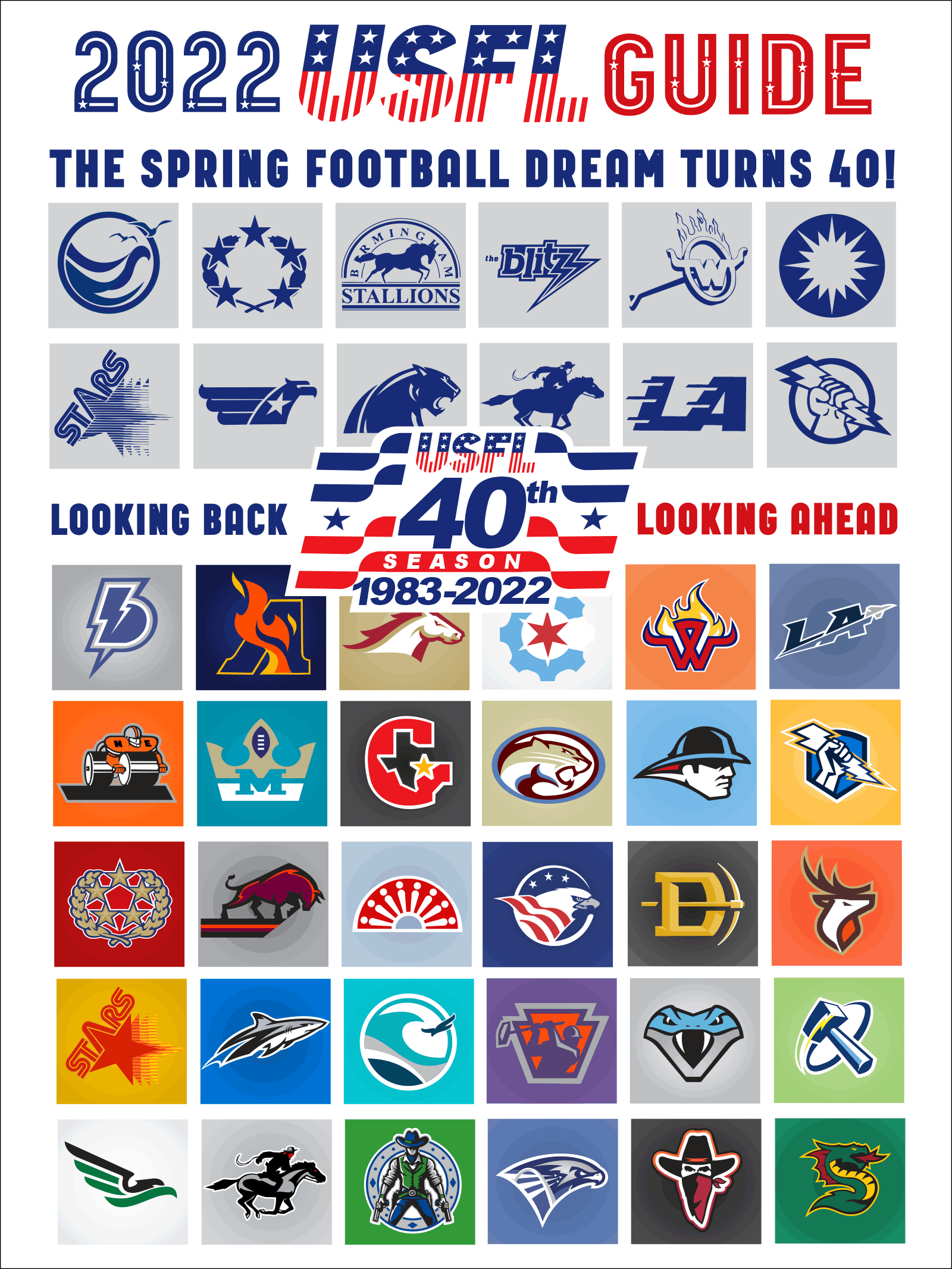
An Acorn to an Oak: The USFL’s Long Journey from Upstart to Empire
When the USFL announced its intention to play high-level professional football in the Spring of 1983, there was certainly novelty to the concept, but there was also a familiar ring to the way the league defined itself. Yes, the concept of a spring football league was new, with early league founders citing their conviction that football could be and should be a year-round sport in the U.S., but there was also a sense that this was yet another attempt to challenge the NFL with the intent to gain access to the lucrative king of professional football. After all, wasn’t that what had happened throughout NFL history, with other “rival” leagues lasting just long enough to force a merger and absorption of teams into the NFL?
We had seen that play out in the 1950’s with the A.A.F.C. sending the Browns, 49ers and Colts into the stronger and more stable league. It was also the outcome of the ambitious American Football League in the 1960’s, producing the AFC and NFC format which has been a stalwart of the NFL for over 50 years. Even the short-lived World Football League, which folded midway through its 2nd season fought to get their Birmingham and Memphis franchises into the NFL. That effort failed, but many could be understood as seeing the 1982 announcement of a new football league as much the same effort.
And there were certainly owners who seemed to share that ambition, evident in the 1984-5 efforts to move the USFL from a spring schedule to a fall season that directly rivaled the NFL. The USFL had already begun making major signings, bringing in Herschel Walker and Mike Rozier in its first two years, back-to-back Heisman winners, and had also raided NFL rosters for players like QB Brian Sipe and safety Gary Barbaro. It was no secret that several owners, led by the New Jersey Generals’ owner, Donald Trump, had sought to force the NFL to consider merger through the combined efforts of a move to fall and a massive anti-trust lawsuit.
The merger talk faded quickly when league owners, led by John Bassett, the owner of the 1983 champion Tampa Bay Bandits persuaded owners that despite early losses, the spring football concept could be a successful venture and that merger was a form of defeat. Bassett’s leadership helped keep the USFL in the spring, and while this thwarted the plans for a quick absorption of several well-heeled teams into the NFL, eventually driving Trump from the league, the long-term vision of Bassett, paired with a financial windfall from the successful anti-trust suit, helped the fledgling USFL gain its footing and build its brand.
Forty years later it is hard to imagine just how shaky the ground under the USFL was at the time, but in the 1980’s, before the term “Summer Bowl” was even invented, the young league struggled with everything from delinquent owners to extravagant expenditures, but it persisted. Yes, the millions from the anti-trust agreement was a huge boon for the league, but so was a steady expansion, bringing in solid franchises (for the most part) and eventually growing from 12 founding franchises to the current 30-team format we enjoy today. It did not happen in a day, or even a decade, it took a long history of compromise, competition, and shared responsibility, but the USFL has reshaped the sports landscape in America, now solidly the 2nd most successful league in the nation, and making professional football the undeniable passion of the American public.
As we look back at the first 40 years of the United States Football League, it is easy to remember the superstars, big games, and highlight reel plays, from Herschel Walker to Bandit Ball, then Jim Kelly’s Run & Shoot, Brett Favre, Robert Drummond, and so many Summer Bowls that were competitive, exciting, and superior in many ways to the often lopsided January NFL title games. It is easy to tell stories of your favorite player, whether a superstar like Calais Campbell, Deuce McCallister, or Jake Plummer, or the lesser-known contributors like LB Putt Choate, TE Adrian Cooper, or even kicker Tim Mazzetti. But, we should also remember the leaders in the C-suites, the owners, the GMs, the team presidents who weathered some tough years, made tough choices, and helped keep the league moving.
Sure, there were frustrating times, and frustrating realities. Some teams just did not make it, some struggled to find a home that provided what they needed, and there were times where supportive fanbases were not enough. No one wanted to see the LA Express leave for St. Louis (only to leave again 2 more times, from St. Louis to Nashville, and finally to Las Vegas), or to see the proud Portland Thunder fanbase watch their team depart for Vegas (and now San Diego). It was tragic that San Antonio lost the Texas Outlaws to a combination of natural disaster and both municipal and private corruption, though we all celebrated this year as the new Gunslinger franchise brought playoff football back to the Alamo City.
The USFL, seen today as a bastion of professional sports, a league that not only rivals, but in some ways surpasses the NFL, in innovation, in daring, and often in creative and engaging play on the field, but it was not always that way, and it certainly was not easy. The rest of our 40-year retrospective will focus on the players, records, and gameplay that made the USFL the “more fun league”, but we felt it was essential to start with the long path the league has taken and the leadership that helped turn upstart into mainstay and longshot into a sure thing.
Looking Back at 40 Seasons of Superstars
As part of our retrospective of 40 years of USFL football, we are going to look at the individual moments, the seasons that created superlatives, and the careers that turned the USFL into America’s spring obsession. We kick it off with a quick look at the league records for all three, individual games, season stats, and career accomplishments. Here is your breakdown of the records across both offense and defense in all three timeframes.

So, what do we see here? Let’s start with the greatest gameday performances of all time. There are certainly many names you will immediately recognize, including the diminutive QB-who-could, Doug Flutie, who threw more passes and completed more than any other player in league history in a single game, tossing up 61 passes and completing 45 in a 1998 Michigan-Houston showdown that saw Flutie and Jim Kelly abandon the run and just keep chucking the ball. You also are likely no stranger to league legends like Joe Cribbs (272 yards in one game), Trumaine Johnson, Marques Colston, Brian Urlacher, or Kurt Gouveia, but for those who may not have been with us in USFL fanship all the way back into the early 1980’s, perhaps the names Cornelius Quarles, Virgil Livers, or Fred Besana are not familiar to you.
For those of us who have followed the USFL since those early days, we remember the league’s opening season, when a lot of players who had not made their names at big time colleges or had seasons of success in the NFL made a mark and put themselves on the map. Cornelius Quarles is perhaps my favorite example. A little known back out of HBCU Howard became a one-season standout for the Birmingham Stallions, moving from fullback to halfback, Quarles would play only one season with the club before Joe Cribbs’s arrival from the NFL, but what a season, putting up 1,407 yards and 17 touchdowns, including the 4-TD masterpiece against Arizona that gave him a record which still stands (others have matched it but no one yet has surpassed it.)
Fred Besana was another early success story for the USFL, Besana had sipped a couple of cups of coffee with the Bills and Giants in the 1970’s but was playing minor league ball with the Twin City Cougars when the USFL came calling. He emerged as an early star of the league, throwing for over 3,700 yards and 26 touchdowns with the 1983 Oakland Invaders. He would lead Oakland over 2 years before serving as a backup to Jim Kelly for 1 year in Houston and retiring after a 1-day contract to return to Oakland. His 6 touchdowns in an early game against the favored Chicago Blitz put him on the map and made him an early superstar for the Invaders, themselves trying to define their club as more than a replacement after the bitter relocation of the Raiders to LA.
The last of our favorite single-game standouts has to be Sam Garcia. Don’t know that name? We are not surprised. Garcia played 12 seasons in the USFL, but appeared in only 6 games, a deep bench backup for Jacksonville most of his career, but in 1984 he was called on to sub for QB Jim Kelly and for one day he was the best QB the USFL has ever seen. In a one-game call-up from the practice squad, Garcia led the expansion Gamblers against the Arizona Wranglers and he played about as well as any QB has ever played, recording a 158.3 QB rating by going 20 of 20 for 218 yards and 2 TDs. It would be his only USFL start as he would move on to the Bulls to back up players like Doug Williams, Chris Miller, and Tony Eason before retiring in 1995. The USFL did not propel him to stardom, but it gave him 12 years as a member of a pro football team and one day that lives on in USFL annals.
Our list of the USFL single-season record holders has perhaps fewer “unknown” players, though we expect that most don’t remember the career of players like Chuck Hartlieb, Elbert Shelley, or Jeff Query. We get the huge names that we all talk about as USFL greats: Calais Campbell, Kerry Collins, Troy Aikman, Herschel Walker, Eric Truvillion and Brian Bosworth, and we have those records that seem untouchable. Will anyone ever top a 25-touchdown year? It has not happened in 37 years since Eric Truvillion set that high bar. Brian Bosworth’s 155 tackles in 1990 stil stands 32 years later. Troy Aikman’s dual record 5,674 yards and 54 TDs in that brilliant Bandit Ball season of 1998 is now more than 20 years old. And while the NFL has seen 5 different players top 2,000 yards in a 16-week season, the USFL still has not had a back top Herschel Walker’s 1983 debut season of 1,767 yards. We certainly cannot imagine that record standing forever, but 40+ years is still an amazing run as the league’s best rushing season.
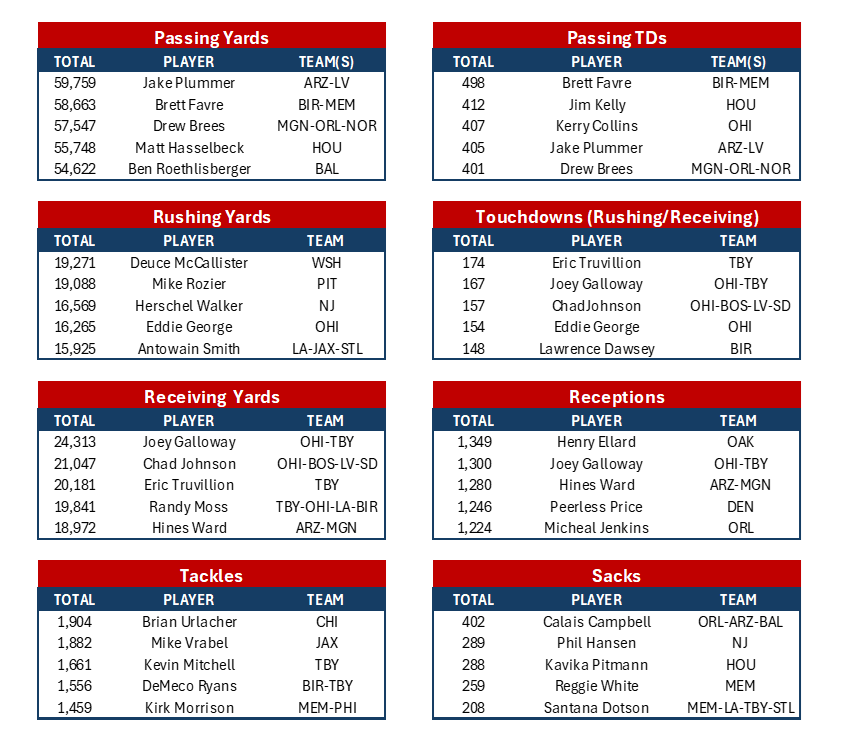
Finally, we have our career leaders, names almost every USFL fan knows by heart. From Doug Flutie and Jake Plummer through Urlacher, Joey Porter, Mike Vrabel, and Calais Campbell, our choice for the Greatest USFL Player of All Time. Not many surprises here as we are all familiar with the superstar careers of the league’s all-time leaders, most of whom are enshrined in Canton at the Pro Football Hall of Fame. What is perhaps most amazing about the career leaders is that so many of their numbers simply dwarf their NFL counterparts. For example, Deuce McCallister’s 19,271 yards rushing tops NFL career rushing leader Emmitt Smith’s 18,355 by nearly 1,000 yards. Likewise, Joey Galloway’s 24,313 yards receiving is more than 1,500 more than Jerry Rice’s legendary numbers in the NFL. And, of course, the most ludicrous difference is among pass rushers, where Bruce Smith, who spent a few years at the end of his career with the USFL, finished his NFL career with 244 NFL sacks, while Calais Campbell’s 402 career sacks dwarfs the former Buffalo Bills’ numbers. The one anomaly, an odd one considering what a passing league the USFL is, is that the USFL career passing yardage leader, Jake Plummer, topped out at 59,759, a number that puts him well below NFL career leaders Peyton Manning (71,940), Philip Rivers (63,948) and Matt Ryan (62,792), though it should be noted that when we combine former General and Invader QB Tom Brady’s USFL and NFL numbers, the 23-year pro football veteran had a career total of 91,202 yards, though only roughly 30,000 of that occurred during his 8 years in the USFL, with the rest coming as a member of the 3-time NFL champion Cowboys.
We finish our look at all time league leaders with a special shout out to one of the few players on our career leader list who has yet to earn a gold jacket in Canton, cornerback Donnell Woolford, the all-time interception leader. Woolford’s 54 career picks over 15 seasons with the Baltimore Blitz seem a glaring omission from the Hall, especially when you add in over 1,200 tackles, 24 furced fumbles and 7 career defensive touchdowns. If members of the Legacy Committee for the Hall are reading this, we think Woolford is long overdue for recognition.
And in recognition that the USFL greatness is not limited to the players who hold leaguewide records, we finish this part of our retrospective with two great lists, the Top 5 players in each of 8 USFL statistical categories (Passing Yards, Passing TDs, Rushing Yards, Receptions, Receiving Yards, Offensive TDs, Tackles and Sacks) both by season and career stats. Lot’s of great players on both lists, and several who take more than one spot in our top 5 seasons lists as well.
THE USFL'S ALL-TIME GREATEST SEASONS: 1983-2022

THE USFL'S GREATEST CAREERS: 1983-2022
Let’s Talk Dynasty
It is a debate topic that simply never fails to bring out passion among USFL fans, which is the greatest dynasty of all time. There are several contenders, with Arizona becoming the latest in the list of teams to win multiple titles in a short span. It all began back in the 1980’s when the Michigan Panthers and Philadelphia Stars alternated titles between 1984-1987, Michigan winning both even-numbered years with the Stars qualifying for the title game in 3 consecutive years and winning the title in both odd-numbered years.
There is no clear “Team of the 90’s” as between 1991-2000 9 different teams brought home the John Bassett Trophy, with the only repeat winner being Jim Kelly’s Houston Gamblers (1992 and 1996). But, if we add in 1990, we get 2 titles for Sam Rutigliano and the Federals. The 2000’s started with one of the greatest back-to-back seasons in league history, with the Ohio Glory going 17-0 to win the title in 2002 and then returning for the league’s first repeat championship in 2003, but that amazing 2-year run was not followed by further playoff success. New Jersey won two titles in the mid-2000’s, with Tom Brady leading the Generals to titles in 2004 and 2006. But if we are looking at sustained success, perhaps we have to consider the Memphis Showboats, who won the title in 1999 and again in 20007, but who also appeared in the 2002 and 2008 Summer Bowls.
Jump to the past 12 years and the debate becomes a 2-team race, between the Arizona Wranglers, who have now won 4 titles in a 10-year span, starting in 2013 and winning every 3rd year since, 2016, 2019, and now in 2022. They are challenged by a Bandits team that won the league title in 2011 and then came back for their own repeat title run in 2020 and 2021. The edge, in most people’s minds, goes to Arizona, not only for their 4 titles, but the fact that they appeared in a total of 6 Summer Bowls in the decade (2013-2022). Hard to argue against that.

We decided to look all time, count up all the appearances and all the victories and provide you with a list of all 40 USFL championships and the all-time record of the 27 teams who have appeared in a title game, from Houston’s 10 appearances to the 0-1 records of the Portland Thunder, St. Louis Knights, LA Express, Charlotte Monarchs, and Texas Outlaws. And yes, we include the hard luck Chicago Machine, 0-3 all-time in the Summer Bowl, as well as the 5 teams to have never lost a Summer Bowl, led by the 3-0 New Jersey Generals. Unfortunately, there will be some teams (We are looking at you, Jacksonville) who have yet to make an appearance, but for these Summer Bowl participants, the debate still rages as to who the USFL’s true blue blood team is. We honestly think there are more than a few, and would list the Bandits, Gamblers, Panthers, and Wranglers as the clear choices. And, one last table for all you USFL data-geeks out there: Our Year-by-Year breakdown of every USFL title game since 1983, complete with venue, score, and MVP of the game.

One Final Word
Forty seasons down, and who knows how many more to come. And whether you have been with the USFL since its awkward “baby deer” steps in 1983, rooting for a team that still sits right where it did 40 years ago, in D.C., Detroit, Oakland, and so many other cities across the country, or if you just signed on in the past few years, perhaps aligning yourself with the newest transplants in San Diego, Las Vegas, Oklahoma, and Boston, we hope you have found This Week in the USFL to be your premier source for all things related to spring football, to this league, its teams, its players, and its legacy. We have loved bringing the USFL to you for 40 years and we are hoping to stay right at the forefront of this great American sports tradition for a long time to come.
A Note from Your Humble Alt-Historian:
To all the folks who have been following this Alt-History, I truly hope you have enjoyed the experience. It may not have always been the truest representation of the USFL, and it certainly took some twists and turns even I did not plan on, but I have loved giving new life to a league that I fell in love with at the age of 16 and whose end came way too soon. Every spring I miss the USFL, and every league that has come and gone since has felt like a pale effort to recapture lightning in a bottle.
I, myself, am going to try to capture that same lightning in a bottle starting in September, when I hope to premier my new project “The WFL Reborn”. I will venture back before my memory of football, into the early 1970’s to envision a World Football League that avoided some of the mistakes that caused it to falter and fail in less than 2 seasons. I will again try my best to produce a realistic alternate timeline, to envision something quite different from the USFL, and to bring a long-dead league back to life. More will come between now and September, and I likely will be seeking your input as well (primarily through the Cris Creamer’s Sportslogos.net message board), but I hope you will join me once again with a new league and a new universe to explore when the WFL Reborn debuts later this year.


This was an awesome project! Thank you for providing us with compelling and entertaining storylines throughout the years. Especially during the pandemic years. Can't wait to see whats in store with your upcoming WFL project. Cheers!👏
Thank you for the years of hard work! It was great fun following along week after week.